

Unlocking Healing Through Somatic Therapy at Royal Lei Academy
Learn how somatic therapy uses breathwork, grounding and gentle movement to release trauma stored in the body and calm your nervous system.

Discover Your Aloha Strength
Answer 7 quick questions to discover the strength at the heart of your aloha, plus a simple 7-day practice to live it every day.

Embracing Healing and Self-Discovery Through Hawaiian Wisdom and Life Coaching
Healing isn't about forgetting — it's about embracing every part of your journey. A gentle reflection on finding peace, strength, and new beginnings.

The Day Google Brought Receipts (and the AI Tried to Fire My Receptionist)
When two AI systems audited the Royal Lei Academy website, they agreed on everything — except whether the receptionist exists. A humorous case study in artificial intelligence, missing spaces, and the
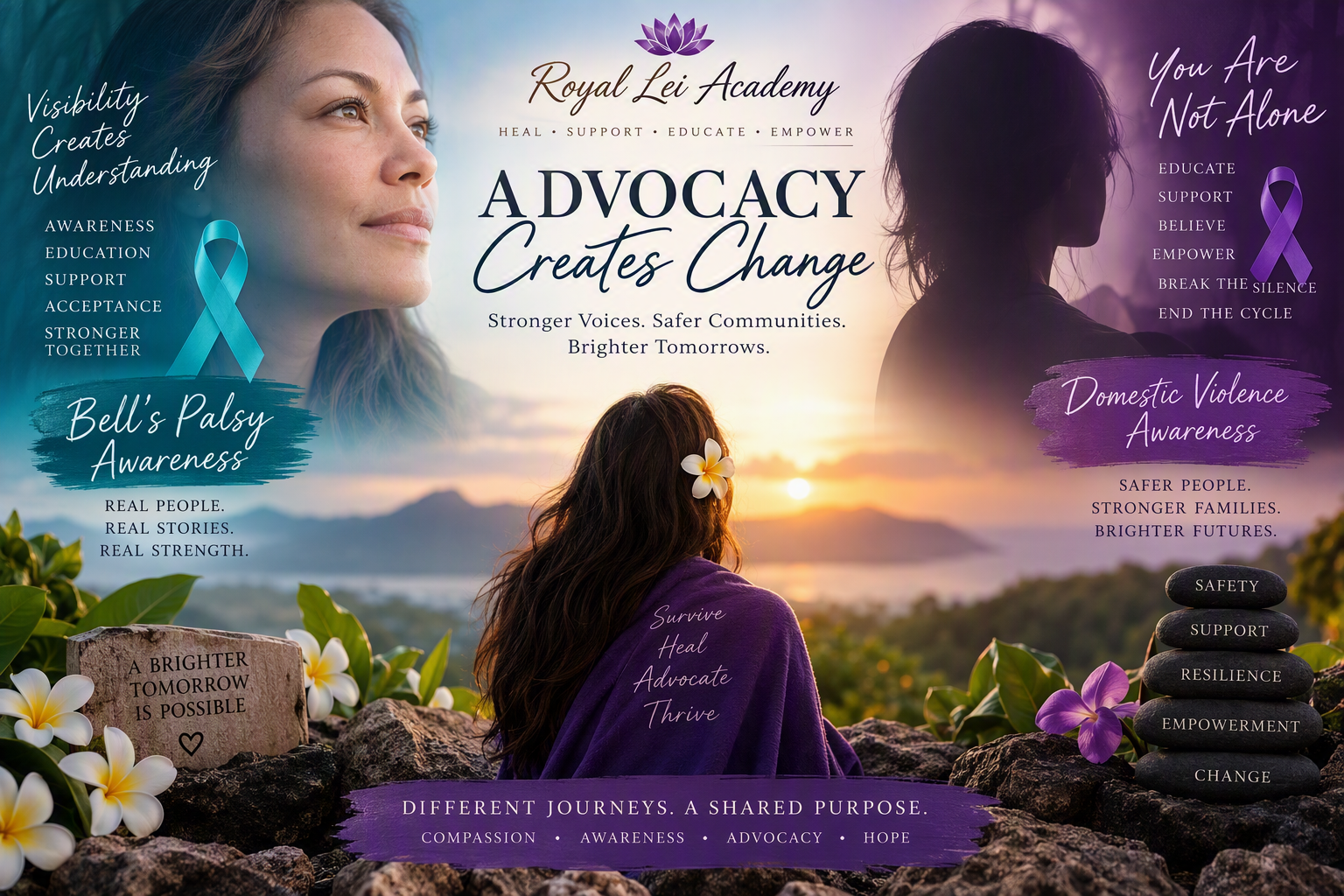
Advocating for bell's palsy and DV
Advocating for Bell's Palsy Survivors and Domestic Violence Survivors: Empowering Voices, Building Awareness, and Creating Change

Empowering Women Through Trauma-Informed Life Coaching and Community Support
How Royal Lei Academy's trauma-informed life coaching and community support help women affected by domestic violence heal and reclaim their power.
Discover Your
Boundary Style
Boundaries aren't walls — they're the way you love yourself out loud.
Discover Your
Boundary Style
Discover Your
Boundary Style
Boundaries aren't walls — they're the way you love yourself out loud.
Answer 7 quick questions about everyday moments, and discover your natural boundary style: what it reveals about your healing, what it costs you, and one small practice to strengthen it.
A somatic-informed self-discovery tool • Coaching, not therapy • Takes about 3 minutes
By Lenka John, Founder — Royal Lei Academy
royalleiacademy.com • Book a free discovery call: calendly.com/lenka6414/30min
Take it online: https://muse.ai/s/discover-your-boundary-style-xkxo6xhxvixoauxne
How this guide works
There are no right or wrong answers — only honest ones. For each question, choose the response that sounds most like you on a real, ordinary day (not your best day, not your worst).
How to score on paper:
Circle one letter (A–E) for each of the 7 questions.
Turn to the Scoring Key and match each letter to a boundary style.
Tally how many times each style appears. Your most frequent style is your result.
If there's a tie, your result is the style you chose earliest in the quiz — that first instinct counts.
A note on language: Every practice in this guide is somatic-informed coaching — gentle, body-based awareness you can do on your own. It is not therapy, and it doesn't replace support from a licensed professional.
The five boundary styles at a glance
Style
In one line
The Open Door
The generous heart with porous boundaries
The Stone Wall
Strong boundaries, built like armor
The Garden Gate
Healthy, flexible boundaries — the goal itself
The Drawbridge
Boundaries that shift with the wind
The Quiet Island
Peaceful on the surface, lonely underneath
The 7 Questions
Circle the one answer that fits you best today. Go with your first instinct.
Question 1 of 7
A good friend asks you for a big favor on a day when you're already running on empty. What do you do?
A. Say yes right away — her need feels more urgent than my exhaustion.
B. Say yes to keep the peace, then quietly pull away for a few days to recover.
C. Check in with myself first, then answer honestly — a full yes, a kind no, or a smaller yes I can actually keep.
D. Say no on the spot — I don't let anyone add to my plate, no exceptions.
E. It depends on who's asking — for her I'd say yes; for someone else, probably not.
Question 2 of 7
Your family expects you at every gathering, and the demands on your time keep stacking up. How do you handle it?
A. I opt out of most of it — skipping is easier than negotiating.
B. I choose the gatherings that matter most and say no to the rest, with love.
C. I show up to everything — they'd be disappointed if I didn't, and I can't stand that feeling.
D. I go when I'm in the mood and make excuses when I'm not — it changes every time.
E. I go, but I stay quiet and count the hours until I can leave.
Question 3 of 7
Your boss drops a last-minute project on your desk when you're already overloaded. What's your move?
A. I speak up — I explain my current load and we agree on what can shift.
B. I take it on and figure it out later, even if it means working late again.
C. If I'm in a good headspace I say yes; if I'm fed up, I push back hard.
D. I accept it silently — and vent about it to everyone except my boss.
E. I refuse flat-out — my workload is my workload, and nobody touches it.
Question 4 of 7
You've finally carved out one hour just for yourself — no errands, no people. Then the guilt creeps in. What happens next?
A. I give the hour away — someone always needs something, and keeping it feels selfish.
B. I notice the guilt, let it pass, and keep my hour — rest is part of how I show up for others.
C. I keep the hour but spend it worrying I'm letting someone down.
D. I don't feel guilty — I decided long ago that my time is mine, period.
E. Some days I protect it fiercely; other days I hand it over without a thought.
Halfway there — notice what your body does as you read these. Tight shoulders, held breath, a little nod — that's information, too.
Question 5 of 7
You finally tell someone "no," and they push back — disappointed, maybe a little guilt-trippy. How do you respond?
A. I go quiet — disappearing feels easier than standing my ground.
B. I shut the whole conversation down — push me once and the door slams.
C. I cave — their disappointment hurts more than my own exhaustion.
D. I stay kind and steady — I can care about their feelings without changing my answer.
E. Sometimes I hold firm, sometimes I fold — it depends on my mood and how hard they push.
Question 6 of 7
You're the one who needs help for once — overwhelmed and can't do it alone. What do you do?
A. I don't ask — I'm the helper, not the helped. People count on me to have it together.
B. I ask, clearly and directly — needing help is human, and I let people show up for me.
C. I handle it myself — depending on people has never ended well for me.
D. I'll ask certain people but never others — it depends on who I trust that day.
E. I drop hints and hope someone notices, instead of asking outright.
Question 7 of 7
You're craving a whole weekend alone — no plans, no people, just quiet. But the invitations are waiting. What wins?
A. It depends on my energy that morning — I might say yes to everything or cancel it all.
B. I make up an excuse to stay home rather than simply saying I'd rather be alone.
C. I honor what I need — I decline warmly and take my weekend, no apology.
D. I say no to everything as a rule — people have mostly stopped inviting me.
E. I say yes to the invitations — alone time can wait; people come first.
Scoring Key — Find Your Style
For each question, find the letter you circled and note the style beside it. Then tally your totals in the box below.
A
B
C
D
E
Q1
Open Door
Quiet Island
Garden Gate
Stone Wall
Drawbridge
Q2
Stone Wall
Garden Gate
Open Door
Drawbridge
Quiet Island
Q3
Garden Gate
Open Door
Drawbridge
Quiet Island
Stone Wall
Q4
Open Door
Garden Gate
Quiet Island
Stone Wall
Drawbridge
Q5
Quiet Island
Stone Wall
Open Door
Garden Gate
Drawbridge
Q6
Open Door
Garden Gate
Stone Wall
Drawbridge
Quiet Island
Q7
Drawbridge
Quiet Island
Garden Gate
Stone Wall
Open Door
Your tally
Boundary Style
Tally marks
Total
The Open Door
The Stone Wall
The Garden Gate
The Drawbridge
The Quiet Island
Your style (most tallies wins; earliest pick breaks a tie): ___________________________________
Now turn to your profile on the next pages. Read the shadow side with compassion — every style was once a smart protection. The practice is your one small next step.
Your Result — The Five Boundary Styles
Find the style you scored highest. Many women recognize pieces of themselves in more than one — start with your top result, then read the others as seasons you may move through.
1. The Open Door
The generous heart with porous boundaries.
What this reveals about your healing path:
You have a heart the size of the ocean, and saying yes is your love language. Somewhere along the way you learned that love means giving — that your needs are an interruption, not a priority. Here's the truth your healing is asking you to hear: your needs aren't the opposite of love. They're part of it. Your path forward is turning that same tenderness you give everyone else toward yourself.
Shadow side:
You run on empty. Every yes to someone else has been a quiet no to yourself, and your body keeps the score — exhaustion, resentment, burnout. Rest feels like guilt because you were taught your worth is measured by what you give, not by who you are.
Somatic-informed practice — The Hand-on-Heart Pause:
Before you answer any request, place one hand on your heart and take one slow breath. Notice: does your chest feel open or tight? Tight is your body asking for a no — or a smaller yes. Let your body vote before your mouth answers.
(Somatic-informed coaching, not therapy.)
Affirmation: "My needs matter as much as anyone else's. I can love people and still choose myself."
• • •
2. The Stone Wall
Strong boundaries, built like armor.
What this reveals about your healing path:
Your boundaries are strong because they had to be. You built that wall for good reason — probably after someone walked all over the softer version of you. That wall protected you, and it deserves respect. Your healing path now is discovering that boundaries can be gates, not just walls — protection that still lets the good stuff in.
Shadow side:
The wall keeps out the hurt, but it also keeps out closeness. Safety without connection can curdle into loneliness. You may catch yourself wondering why, with all this protection in place, you still feel alone.
Somatic-informed practice — The Softening Breath:
Place both hands on your ribcage and breathe in slowly, feeling your ribs expand — notice the space your body makes for air. As you exhale, whisper to yourself: "I can let a little in." You're teaching your nervous system that openness doesn't have to mean danger.
(Somatic-informed coaching, not therapy.)
Affirmation: "I am safe — and I am allowed to let good people in."
• • •
3. The Garden Gate
Healthy, flexible boundaries — the goal itself.
What this reveals about your healing path:
You've done the deep work — or you got here the long way, through trial and error. You can say yes with a full heart and no with a clear conscience, and you state your needs without apology or aggression. Your healing path now is maintenance — and maybe showing other women that this is possible.
Shadow side:
Even garden gates need oiling. When you're depleted, old patterns creep back — the yes that should have been a no, the need you swallow instead of speaking. Your work is catching the early signs and tending your own garden first.
Somatic-informed practice — The Grounding Check-In:
Stand with your feet flat on the floor and press down gently, feeling steadiness rise through your legs. Ask your body: "What do I need right now?" Trust the first answer that comes. This keeps your inner compass calibrated.
(Somatic-informed coaching, not therapy.)
Affirmation: "My yes means yes, my no means no — and both are given with love."
• • •
4. The Drawbridge
Boundaries that shift with the wind.
What this reveals about your healing path:
Your boundaries change with the weather — firm with some people, soft with others, shifting with your mood or your energy that day. That usually means you're reading the room instead of reading yourself. Your healing path is building one steady standard that belongs to you — not to whoever happens to be asking.
Shadow side:
Inconsistency confuses people, and it confuses you most of all. You swing between guilt ("I gave in again") and harshness ("Why was I so rigid with them?"). The unpredictability is exhausting — for everyone, but especially for you.
Somatic-informed practice — The Anchor Breath:
Before you respond to any request, pause and breathe slowly down into your belly. Feel your feet on the ground. Then ask: "What would I say if my energy were steady?" Let that answer — not the mood of the moment — guide you.
(Somatic-informed coaching, not therapy.)
Affirmation: "I can be steady. My boundaries don't have to change with the wind."
• • •
5. The Quiet Island
Peaceful on the surface, lonely underneath.
What this reveals about your healing path:
You don't fight about boundaries — you disappear around them. Going silent feels safer than the conflict of speaking up, so you retreat to your island and wait for the storm to pass. Your healing path is finding your voice in small, safe doses — and discovering that you can say what you need and the people who matter will still be there.
Shadow side:
Silence looks like peace, but it's lonely in there. People can't meet needs they don't know about, and resentment builds quietly under the calm surface. You end up feeling unseen — partly because you've made yourself invisible.
Somatic-informed practice — The Voice Warm-Up:
Place a hand gently on your throat and hum softly for three slow breaths, feeling the vibration. Then say one true sentence out loud — even just to yourself: "I need some quiet today." This gently reconnects your voice to your needs.
(Somatic-informed coaching, not therapy.)
Affirmation: "My voice matters. I can speak my needs and still be loved."
7-Day Boundary Practice Tracker
Pick the practice from your result profile and try it once a day for a week. Small, steady reps are how a Garden Gate is built — no perfection required.
Day
My practice today
What I noticed in my body
✓
Day 1
Day 2
Day 3
Day 4
Day 5
Day 6
Day 7
End-of-week reflection
The boundary moment I'm most proud of this week was…
My body told me _______, and next time I will…
One kind no I want to practice next week is…
Your Next Step
Want support strengthening your boundaries?
Book a free discovery call with Lenka — 30 minutes, no pressure, just a conversation about your next chapter.
calendly.com/lenka6414/30min
Explore more at Royal Lei Academy
https://www.royalleiacademy.com/
Take this quiz online: https://muse.ai/s/discover-your-boundary-style-xkxo6xhxvixoauxne
Disclaimer: This quiz and its practices are somatic-informed coaching tools for self-discovery and personal growth. They are educational in nature and are not therapy, diagnosis, or medical treatment. If you are in crisis or need clinical support, please reach out to a licensed professional in your area.
© Royal Lei Academy. Created for your personal reflection — please don't reproduce for commercial use without permission. Questions about coaching? Reach Lenka through royalleiacademy.com.
DISCOVER YOUR RELATIONSHIP STYLE
A Royal Lei Academy Quiz Companion Seven questions. Five styles. One wiser heart. Find your pattern in love
DISCOVER YOUR RELATIONSHIP STYLE A Royal Lei Academy Quiz Companion Seven questions. Five styles. One wiser heart. Find your pattern in love — and the practice that helps you love better. How This Quiz Works Answer each of the 7 questions honestly — go with your first instinct, not the answer you wish were true. Each answer points to one of five relationship styles. Count how many times you chose each style. The style you chose most often is your result. Tie? Go with the style you picked first in the quiz — your gut knew before your head caught up. There are no bad results here. Every style has a gift — and a growing edge. This quiz simply shows you yours. The 7 Questions 1. The morning-after text It's the morning after a really good first date, and he texts: "I had a great time. Dinner Friday?" What's your first move? • [The Romantic] Say yes right away — when it feels right, why play games? • [The Guardian] Wait a bit before answering — I need to think, and I don't want to seem too eager. • [The Free Spirit] Check my calendar and my gut — I want to go, but I need my own plans protected too. • [The Giver] Say yes — and immediately start thinking of something thoughtful to do for him. • [The Dreamer] Replay the whole date in my head first — was it actually great, or am I just excited someone asked? My pick: ____________________ 2. The undefined month You've been seeing someone for a month. Things are good, but he hasn't said what "this" is. What do you do? • [The Guardian] Bring it up directly — I need to know where I stand before I invest more. • [The Dreamer] Wait — if it's real, it'll define itself. I don't want to ruin the magic by labeling it. • [The Romantic] I'm already all in emotionally — a label feels like a formality at this point. • [The Free Spirit] Honestly, I like it undefined — labels feel like a cage closing in. • [The Giver] I focus on making him happy and hope he brings it up — I don't want to pressure him. My pick: ____________________ 3. The setup A friend says, "I know someone perfect for you." What's your honest first reaction? • [The Dreamer] Excitement — maybe THIS is the one I've been waiting for. • [The Guardian] Suspicion — "perfect" for who? I'll believe it when I see it. • [The Free Spirit] Hesitation — dating feels like effort I'd rather spend on my own full life. • [The Romantic] Yes, set it up — I love the possibility of meeting someone new. • [The Giver] Sure — and I immediately wonder whether HE is lonely, whether he's okay, whether I can help. My pick: ____________________ 4. The cancelled plans He cancels your plans last minute with a vague excuse. What's your move? • [The Guardian] I pull back — a vague cancellation tells me everything about his priorities. • [The Romantic] I tell him I'm disappointed — honestly, no games. I'd rather be real about it. • [The Free Spirit] Honestly, a free evening sounds kind of great — I'll enjoy my own plans. • [The Giver] I tell him it's totally fine — then feel hurt and say nothing about it. • [The Dreamer] I spiral a little — was it ever real? Maybe I imagined the whole connection. My pick: ____________________ 5. The tender moment Things are going well, and he looks at you and says, "I really love spending time with you." What happens inside you? • [The Romantic] My heart melts — this is what I've been waiting to hear. • [The Guardian] A small voice asks: does he mean it? I need more than words. • [The Free Spirit] Warmth — with a flicker of fear that this is getting serious. • [The Giver] I immediately think about how to make HIM feel that loved back. • [The Dreamer] It's sweet — but I catch myself comparing this moment to the movie version in my head. My pick: ____________________ 6. The one-sided effort You notice you've been doing all the planning, all the checking in, all the caring. What do you do? • [The Giver] Keep going — that's just how I love. Slowing down feels like not caring. • [The Guardian] I stop first and watch — if he doesn't step up, I have my answer. • [The Romantic] I don't mind — when I love someone, giving is the easy part. • [The Free Spirit] I pull back to reclaim my space — I need to feel like myself again. • [The Dreamer] I wonder if this means he's not "the one" — the one would just know. My pick: ____________________ 7. The steady man A kind, steady man — good values, makes you laugh, but no fireworks — asks you out. What do you do? • [The Dreamer] I hesitate — I want the spark. Settling scares me more than being alone. • [The Guardian] I say yes — character matters more than chemistry. Chemistry can grow. • [The Romantic] I say yes — I fall fast, and a good man is a beautiful start. • [The Free Spirit] I say yes — but I keep my freedom guarded. Steady is fine as long as I stay me. • [The Giver] I say yes — and immediately start thinking about what he might need from me. My pick: ____________________ My Score Tally Count your picks for each style and write the totals here: The Romantic: _____ The Guardian: _____ The Free Spirit: _____ The Giver: _____ The Dreamer: _____ My relationship style is: ____________________ The Romantic Leads with her whole heart. What this reveals about your healing path You love the way some people breathe — fully, immediately, without holding back. That capacity is a gift, and the world needs more of it. Your healing path isn't about loving less. It's about letting someone earn the love you give so freely — pacing your beautiful heart so it lands somewhere worthy of it. Shadow side You can fall faster than trust can form. When it breaks, it breaks big — and in the rush, red flags get mistaken for butterflies. Your heart deserves a slower runway. Somatic-informed practice The Pause Before the Plunge: When you feel yourself falling fast, place one hand on your heart and take three slow breaths. Then ask: "What do I actually know about this person so far?" Let the facts catch up with the feeling. These practices are somatic-informed coaching, not therapy. Affirmation "My big heart is a gift — and I can give it at a pace that honors me." The Guardian Protects her heart like treasure. What this reveals about your healing path You've been hurt, and you learned. Your caution is wisdom, not damage — it was earned. That discernment will serve you beautifully in choosing the right person. Your healing path now is making sure the checkpoint doesn't become a fortress: vetting is wise, but at some point, someone good has to be let through the gate. Shadow side When every date is an interrogation, good people give up. The wall that kept out the wrong ones can quietly keep out the right one too — and safety without closeness curdles into loneliness. Somatic-informed practice The Window Crack: Notice one small, low-stakes way to let someone in this week — share a real opinion, accept a small kindness without deflecting, let a compliment land. Small openings teach your nervous system that not everyone is a threat. These practices are somatic-informed coaching, not therapy. Affirmation "I can be careful and still be open. Discernment is not the same as distance." The Free Spirit Loves her independence fiercely. What this reveals about your healing path You've built a life you genuinely love, and you're not handing the keys to just anyone — that's strength, not avoidance. Your healing path is discovering that the right relationship doesn't shrink your world. Love, done right, doesn't cage the free spirit. It gives her somewhere worth landing. Shadow side Keeping one foot out the door means never fully landing. Partners can feel the distance even when you're right beside them — and "I need space" can become a reflex that fires even when your heart wants to stay. Somatic-informed practice The Both-And Breath: Breathe in slowly and silently say "I am free." Breathe out slowly and say "I am loved." Let your body feel both truths at once, until they stop feeling like opposites. These practices are somatic-informed coaching, not therapy. Affirmation "Love doesn't shrink my life — the right love makes it bigger." The Giver Loves by taking care of everyone. What this reveals about your healing path Your love language is service, and it is genuinely beautiful. But somewhere along the way you learned that your needs were too much — so you made yourself essential by being endlessly useful. Your healing path is choosing someone who pours back: a partner, not a project. Shadow side Givers attract takers. You disappear into his needs, his moods, his life — and one day you look up and can't find yourself in the relationship. Exhaustion starts to feel like love, and it isn't. Somatic-informed practice The Receiving Practice: This week, let someone do one small thing for you — a compliment, a favor, a kindness — without deflecting, minimizing, or rushing to repay it. Notice the discomfort, breathe through it, and let it land. Receiving is a muscle. Build it. These practices are somatic-informed coaching, not therapy. Affirmation "I deserve the same care I give so freely. I can receive, too." The Dreamer In love with love itself. What this reveals about your healing path You hold a beautiful vision of love — don't let anyone talk you out of wanting something extraordinary. The problem was never the dream. It's that the dream edits out real, imperfect people. Your healing path is letting real be enough: a good man, a real connection, a love that looks like Tuesday, not a movie. Shadow side Perpetual almost-love. The spark becomes the whole test, so steady, kind, devoted people get overlooked while you wait for a feeling. Waiting starts to feel like wisdom, but it's often just fear in a pretty dress. Somatic-informed practice The Real-Life Inventory: After any date or interaction, name three genuinely good things about the real person in front of you — no "but," no comparison to the fantasy. Train your eyes to see what's actually there. These practices are somatic-informed coaching, not therapy. Affirmation "Real love is better than perfect love. I choose what's real." 7-Day Love-Wiser Tracker One small line a day. Notice your pattern in real life — that's where the shift happens. Day 1 Today I noticed my style show up when: _________________________________ What I did differently: _______________________________________________ One kind thing I did for myself: _______________________________________ Day 2 Today I noticed my style show up when: _________________________________ What I did differently: _______________________________________________ One kind thing I did for myself: _______________________________________ Day 3 Today I noticed my style show up when: _________________________________ What I did differently: _______________________________________________ One kind thing I did for myself: _______________________________________ Day 4 Today I noticed my style show up when: _________________________________ What I did differently: _______________________________________________ One kind thing I did for myself: _______________________________________ Day 5 Today I noticed my style show up when: _________________________________ What I did differently: _______________________________________________ One kind thing I did for myself: _______________________________________ Day 6 Today I noticed my style show up when: _________________________________ What I did differently: _______________________________________________ One kind thing I did for myself: _______________________________________ Day 7 Today I noticed my style show up when: _________________________________ What I did differently: _______________________________________________ One kind thing I did for myself: _______________________________________ Ready to love wiser? Book a free discovery call with Lenka and talk through what your style means for your next chapter. calendly.com/lenka6414/30min www.royalleiacademy.com
Unlocking Healing Through Somatic Therapy at Royal Lei Academy
Discover the Power of Somatic Healing
At Royal Lei Academy, we believe healing is a journey that integrates both mind and body. Somatic therapy offers a unique approach to healing trauma, stress, and emotional pain by focusing on bodily sensations and the mind-body connection. This blog post explores what somatic healing is, how it works, and why it can be a transformative practice for anyone seeking deeper personal growth and wellness.
Somatic healing is rooted in the understanding that trauma and emotional distress are not just mental experiences but are also stored physically in the body. Traditional talk therapy often addresses thoughts and emotions, but somatic therapy brings the body into the healing process, helping individuals reconnect with their physical sensations and release stored tension. This holistic approach is especially valuable for those recovering from trauma, including survivors of domestic violence and individuals facing chronic stress.
How Somatic Therapy Works: Principles and Techniques
Somatic therapy integrates mind-body exercises such as breathwork, movement, and mindful awareness to help people process trauma and regulate their nervous system. By cultivating somatic awareness—the conscious perception of bodily sensations—clients can identify where tension or trauma is held and gently release it. Techniques include somatic experiencing, mindful breathing, body scans, and guided movement, all designed to restore balance and promote healing.
- Somatic Experiencing: Recognizing and releasing trauma stored in the body.
- Somatic Release: Using movement to discharge tension and trapped energy.
- Body Scan Meditation: Developing awareness of physical sensations.
- Grounding Techniques: Connecting with the present moment through sensory experience.
- Somatic Yoga: Embodied movement practices to soothe the nervous system.
These techniques can be tailored to individual needs and incorporated into therapeutic sessions or practiced independently. For example, somatic yoga allows for gentle exploration of physical sensations while promoting relaxation and body awareness. Grounding exercises, such as feeling your feet on the earth, help anchor you in the present and reduce anxiety. Each method supports the body’s natural ability to heal and return to a state of calm.
It’s important to recognize that somatic therapy complements, rather than replaces, traditional mental health treatments. Especially for those with complex trauma or chronic conditions, integrating somatic practices with talk therapy or medical care can enhance overall healing. Additionally, somatic healing requires a safe, supportive environment and professional guidance to ensure that emotional releases are managed carefully and constructively.
If you're interested in exploring somatic therapy, start by finding a qualified therapist experienced in trauma-informed care, or try gentle somatic exercises such as mindful breathing or body scans at home. Royal Lei Academy offers coaching and resources designed to support women in healing from trauma and reclaiming their strength through holistic, body-centered approaches. Remember, healing is a gradual process, and small, consistent steps can lead to profound transformation.
In summary, somatic therapy bridges the gap between mind and body, offering a powerful path to healing emotional wounds stored physically. At Royal Lei Academy, we are dedicated to empowering individuals, especially women, to embrace this holistic approach and bloom into their fullest potential. If you or someone you know is ready to begin this healing journey, consider integrating somatic therapy into your wellness plan and experience the profound benefits of body-aware healing.
Discover Your Aloha Strength
ROYAL LEI ACADEMY
ROYAL LEI ACADEMY
Discover Your Aloha Strength
A 7-question quiz to name the strength already blooming in you
A workbook for women healing from life's challenges,
reclaiming their inner strength, and creating a life of purpose,
confidence, and fulfillment.
royalleiacademy.com • calendly.com/lenka6414/30min
Aloha, beautiful soul.
Every woman who finds her way to Royal Lei Academy already carries a strength at the center of who she is. It is the way she loves. It is the way she keeps going. It is the way she makes a room feel safe, or a hard season feel survivable. Most of us were never given a name for it — so we call it luck, or stubbornness, or "just how I am."
This little quiz gives it its true name: your Aloha Strength.
In Hawaiian wisdom, Aloha is so much more than hello. It is a way of living — Akahai (kindness, expressed with tenderness), Lokahi (unity, expressed with harmony), Oluolu (agreeableness, expressed with pleasantness), Haahaa (humility, expressed with modesty), and Ahonui (patience, expressed with perseverance). One of these five lives strongest in you. Let us find out which one.
There are no wrong answers here. Answer with your first, honest instinct — the answer that feels like you on an ordinary Tuesday, not the woman you think you should be.
How to take this quiz
1. Answer all 7 questions. Check one box per question.
2. Write the letter of each answer in the scoring grid after the questions.
3. Count your letters. Your most-frequent letter is your Aloha Strength.
4. Turn to your result page and read your personalized practice.
5. Take the 7-day Aloha Strength practice — one small action a day.
Give yourself ten quiet minutes, a pen, and a cup of something warm. You have earned all three.
Question 1 of 7
When life gets hard, what do you reach for first?
☐ A. The people who steady me — and I steady them right back.
☐ B. A kind word, a soft place to land, a gentler way through.
☐ C. Time, breath, and the long view. This will pass.
☐ D. Calm. I lower the temperature before anything else.
☐ E. A quiet moment alone to listen inward and begin again.
Question 2 of 7
A friend is hurting. Your first instinct is to…
☐ A. Gather everyone who loves her. Nobody heals alone.
☐ B. Show up with food, a hug, and zero judgment.
☐ C. Sit with her as long as it takes. No rushing her tears.
☐ D. Bring peace into the room — soft voice, soft energy.
☐ E. Hold space quietly, then share what helped you.
Question 3 of 7
People who know you best would say you are…
☐ A. The glue. You hold everyone together.
☐ B. The soft heart. Everyone feels safe with you.
☐ C. The steady one. Storms do not move you.
☐ D. The calm. Your presence settles a room.
☐ E. The quiet strength. You have survived things and stayed kind.
Question 4 of 7
Your ideal morning looks like…
☐ A. Coffee and conversation with someone you love.
☐ B. Something nurturing — a slow breakfast, a note to a friend.
☐ C. Unhurried. The day will unfold in its own time.
☐ D. Peaceful — soft music, soft light, soft start.
☐ E. Still. A journal, a prayer, a breath before the world wakes.
Question 5 of 7
When you have hurt someone, you…
☐ A. Bring everyone together and make it right, face to face.
☐ B. Apologize with your whole heart, then show it in action.
☐ C. Give it time, then return when hearts have cooled.
☐ D. Choose gentle words and listen more than you speak.
☐ E. Own your part honestly — no excuses, no hiding.
Question 6 of 7
The compliment that would mean the most to you is…
☐ A. "You make everyone feel like they belong."
☐ B. "Your kindness changed my life."
☐ C. "You never gave up — on us, or on yourself."
☐ D. "Being near you feels like exhaling."
☐ E. "You turned your pain into wisdom."
Question 7 of 7
Finish this sentence: A strong woman…
☐ A. builds a circle and lifts everyone in it.
☐ B. leads with tenderness and means it.
☐ C. keeps her heart open through every season.
☐ D. carries peace wherever she goes.
☐ E. rises quietly, again and again, without bitterness.
Your Aloha Strength
Write the letter you checked for each question, then count how many times each letter appears.
Q1
Q2
Q3
Q4
Q5
Q6
Q7
Letter:
______
______
______
______
______
______
______
Tally
A
B
C
D
E
My count:
_____ / 7
_____ / 7
_____ / 7
_____ / 7
_____ / 7
My most-frequent letter: _______ My Aloha Strength: ____________________
Tied? Trust the result that made you nod. Your body already knows.
A
Lokahi
Unity
B
Akahai
Kindness
C
Ahonui
Steady Heart
D
Oluolu
Grace
E
Haahaa
Gentle Strength
A — Lokahi: The Strength of Unity
You are the glue.
Lokahi means unity, expressed with harmony — and it is written all over your life. You build circles. You remember birthdays, check on the quiet ones, and make sure nobody at the table feels like a stranger. When things fall apart, your instinct is to gather, not scatter. That is not small. That is leadership, the Hawaiian way.
Watch for this
You may give so naturally that you forget to receive. Belonging has to include you, beloved — not just the people you hold together.
Your somatic-informed practice
Place one hand on your heart and one on your belly. Breathe in for four counts, out for six, three rounds. With each exhale, picture your circle — and picture yourself inside it, held, not just holding. Repeat: "I belong in my own circle."
Try this today
Send one "thinking of you" message today — and before bed, ask yourself: who held me today? Let the answer be a person, not a task list.
B — Akahai: The Strength of Kindness
You are the soft heart.
Akahai means kindness, expressed with tenderness — and tenderness is your native language. You notice the wince other people miss. Your words land gently, your forgiveness comes honestly, and people leave your presence breathing easier than when they arrived. In a hard world, softness like yours is not weakness. It is a discipline.
Watch for this
Your kindness may flow outward so freely that very little pools for you. The voice you use on everyone you love deserves an audience of one: you.
Your somatic-informed practice
Pour yourself something warm. Hold the cup in both hands and feel its heat — that is kindness you can touch. Now write yourself one sentence in the tender voice you reserve for your dearest friend. Read it aloud. Let it land.
Try this today
Do one kind thing for a stranger and one kind thing for yourself today. Both count. Both are practice.
C — Ahonui: The Strength of the Steady Heart
You are the steady one.
Ahonui means patience, expressed with perseverance — the strength of the woman who stays. You have weathered seasons that would have flattened anyone else, and you did it without hardening. You trust timing. You let healing take the time healing takes. People lean on your steadiness the way they lean on a strong railing: without even thinking about it.
Watch for this
Steadiness can quietly become waiting — for permission, for the perfect moment, for everyone else to go first. Your season counts too.
Your somatic-informed practice
Stand with your feet flat on the floor. Rock slowly forward and back, finding the exact point where you feel most balanced. Breathe there for one minute. That point is yours. Return to it whenever the ground feels shaky.
Try this today
Name one thing you have been patiently waiting to begin. Take the smallest possible first step today — ten minutes, one phone call, one page.
D — Oluolu: The Strength of Grace
You are the calm.
Oluolu means agreeableness, expressed with pleasantness — grace in motion. You lower the temperature of every room you enter. Your presence feels like an exhale: shoulders drop, voices soften, and hard conversations become possible. You have made an art of responding instead of reacting, and it has carried you — and everyone near you — through more than they know.
Watch for this
Grace can become swallowing your own truth to keep the peace. Your voice is part of the harmony, not a threat to it.
Your somatic-informed practice
Roll your shoulders back three times, slowly, letting each exhale drop them further. Unclench your jaw. Soften your hands open. Whisper: "Peace includes my truth." Feel how the calm stays — and now it has room for you in it.
Try this today
Say one true, gentle thing today that you would normally smooth over. Kind delivery, honest content. Watch the peace survive it.
E — Haahaa: The Strength of Gentle Strength
You are the quiet strength.
Haahaa means humility, expressed with modesty — and yours is the strength that rises without noise. You have survived things you do not make speeches about. You ask for help without shame, you tell the truth about your part, and you have turned pain into wisdom instead of bitterness. There is nothing fragile about your gentleness. It is forged.
Watch for this
You may downplay what you have survived so thoroughly that you forget to honor it. Quiet does not have to mean invisible — least of all to yourself.
Your somatic-informed practice
Sit tall, palms open in your lap. Breathe in and name (silently) one hard thing you survived. Breathe out and name what it taught you. Three rounds. This is your evidence file. You built it. Claim it.
Try this today
Write down one survival you have never once congratulated yourself for. Tonight, thank that woman — out loud, by name: yours.
Your 7-Day Aloha Strength Practice
One small action a day. Small is not a compromise — small is how strength becomes a habit. Check each day off as you go.
☐ Day 1 — Name it: Write your Aloha Strength on a sticky note. Put it where you will see it every morning.
Notes: _______________________________________________________________
☐ Day 2 — Notice it: Catch your strength in action once today. Write down the moment tonight.
Notes: _______________________________________________________________
☐ Day 3 — Share it: Tell one trusted person your result. Let them say, "Yes — that is so you."
Notes: _______________________________________________________________
☐ Day 4 — Stretch it: Use your strength somewhere new: work, a hard conversation, a brave decision.
Notes: _______________________________________________________________
☐ Day 5 — Soften the shadow: Re-read the "Watch for this" note on your result page. Choose one gentle correction.
Notes: _______________________________________________________________
☐ Day 6 — Celebrate it: Do something that honors how far this strength has carried you. You name what counts.
Notes: _______________________________________________________________
☐ Day 7 — Decide: Your strength got you here. Imagine what it could do with support. See the invitation below.
Notes: _______________________________________________________________
A note before you go
Naming your strength is the first step. Living from it — on purpose, with guidance, in a circle of women who get it — is the next one. That is exactly the work we do at Royal Lei Academy: compassionate, mind-body-spirit coaching for women healing from life's challenges and creating a meaningful next chapter.
If this quiz stirred something in you, I would love to hear about it. Book a free 30-minute discovery call — no pressure, no pitch, just a real conversation about your next chapter.
Book your free discovery call: calendly.com/lenka6414/30min
royalleiacademy.com • Lenka6414@icloud.com
With Aloha,
Lenka John, Founder — Royal Lei Academy
Educational coaching content — not therapy, diagnosis, or medical advice.
I love this idea because it fits the personality of your site. Instead of pretending everything appeared magically, you're acknowledging the tools that helped along the way.